Describe Ra-Hoor-Khuit to a Buddhist
-
How would you describe Ra-Hoor-Khuit to a Buddhist who "knows his stuff"?
(knows his stuff, i.e. Buddhist stuff, but not necessarily others' stuff) -
How would you describe Ra-Hoor-Khuit to a Buddhist who "knows his stuff"?
(knows his stuff, i.e. Buddhist stuff, but not necessarily others' stuff) -
How would you describe Ra-Hoor-Khuit to a Buddhist who "knows his stuff"?
(knows his stuff, i.e. Buddhist stuff, but not necessarily others' stuff)Am I too late to lend words on this matter?
"Success is thy proof: argue not; convert not; talk not overmuch!"
- AL III:42
Ra-Hoor-Kuit is the magician, as the Buddha is the proverbial mystic. One is active, the other passive. The goal is the necessarily equivalent, though the approach is seemingly divergent. RHK is dynamic, Buddha is dynamically passive. Um, just brainstorming...

"The light is mine; its rays consume
Me: I have made a secret door
Into the House of Ra and Tum,
Of Khephra and of Ahathoor.
I am thy Theban, O Mentu,
The prophet Ankh-af-na-khonsu!
By Bes-na-Maut my breast I beat;
By wise Ta-Nech I weave my spell.
Show thy star-splendour, O Nuit!
Bid me within thine House to dwell,
O wingèd snake of light, Hadit!
Abide with me, Ra-Hoor-Khuit!"Try to sell him candy... And remember, the first real question to ask is "does power corrupt?" It's not so much the sources that need corrected, but, then again, maybe it is...
"Nothing is a secret key of this law. Sixty-one the Jews call it; I call it eight, eighty, four hundred & eighteen."
Nirvana literally means "to blow out." Nirodha is cessation. Match that with Nuit's words.
-
How would you describe Ra-Hoor-Khuit to a Buddhist who "knows his stuff"?
(knows his stuff, i.e. Buddhist stuff, but not necessarily others' stuff) -
How would you describe Ra-Hoor-Khuit to a Buddhist who "knows his stuff"?
(knows his stuff, i.e. Buddhist stuff, but not necessarily others' stuff)@zeph said
"Atman?"
The concept of Atman is anathema to Buddhism. Nirvana is the cessation of all conceptualization of a self or whom one is. The supposed discrepancy between Atman and Nirodha is a difference in dialogue and philosophy, however. In practice they are one and the same. Do you think that Buddhists see rocks and mud and other things devoid of consciousness as "enlightened?"
In terms of Thelema, Atman would be closest to Hadit, the Innermost Self. Ra-Hoor-Khuit is the dynamic aspect of passivity. It represents the destructive force which actively annihilates one's beliefs and preconceived expectations, which are the harbors of Choronzon's ships. RHK's chapter of Liber AL also introduces the most Crowleyian part of the book, indulging the man's fantasies of being the top dog. A world religion with him as the prophet and sole authority? Consider that the term "Beast" appears only once in chapter 1, no times in chapter 2 (except when describing objects), but then is peppered throughout 3.
-
How would you describe Ra-Hoor-Khuit to a Buddhist who "knows his stuff"?
(knows his stuff, i.e. Buddhist stuff, but not necessarily others' stuff)@Takamba said
"If you meet Ra-Hoor-Khuit on the road, kill him.
or fill him
I don't know anymore!"
Is that your way of telling the Buddhist "You are not going to like this guy..."?
BTW, was the kill->fill change made by the OTO? If so, doesn't it violate the command not to change even the style of a letter in this book?
@Hermitas said
"I don't know my Buddhist stuff, so...
But my dilettante's answer would be "Buddha defying Mara.""
Interesting! Very simple and quite accurate (as far as my Understanding goes).
@seekinghga said
"Am I too late to lend words on this matter?
"Success is thy proof: argue not; convert not; talk not overmuch!"
- AL III:42
Ra-Hoor-Kuit is the magician, as the Buddha is the proverbial mystic. One is active, the other passive. The goal is the necessarily equivalent, though the approach is seemingly divergent. RHK is dynamic, Buddha is dynamically passive. Um, just brainstorming...
"The light is mine; its rays consume
Me: I have made a secret door
Into the House of Ra and Tum,
Of Khephra and of Ahathoor.
I am thy Theban, O Mentu,
The prophet Ankh-af-na-khonsu!
By Bes-na-Maut my breast I beat;
By wise Ta-Nech I weave my spell.
Show thy star-splendour, O Nuit!
Bid me within thine House to dwell,
O wingèd snake of light, Hadit!
Abide with me, Ra-Hoor-Khuit!"Try to sell him candy... And remember, the first real question to ask is "does power corrupt?" It's not so much the sources that need corrected, but, then again, maybe it is...
"Nothing is a secret key of this law. Sixty-one the Jews call it; I call it eight, eighty, four hundred & eighteen."
Nirvana literally means "to blow out." Nirodha is cessation. Match that with Nuit's words."
Nope, you're not too late. The comparison between a Buddha and RHK is interesting.
And what do you mean by "Try to sell him candy"?@zeph said
"Atman?"
Atman is a Hindu concept, and it is a major point of difference with Buddhism, as seekinghga mentioned. So I don't think it would fit, but thanks anyway.

-
How would you describe Ra-Hoor-Khuit to a Buddhist who "knows his stuff"?
(knows his stuff, i.e. Buddhist stuff, but not necessarily others' stuff)@FiatYod said
"
The comparison between a Buddha and RHK is interesting."RHK is EXTREMELY dynamic, outgoing, opposite-of-introverted. It is that aspect of Horus which embodies spiritual or magical results of that manner. Buddha sits and lets it all fade around him. RHK confronts it all until it is mastered and it falls around him, AND that means as everything that is not Hadit.
"And what do you mean by "Try to sell him candy"?"
I was being literal. There are lots of candies which serve as blessings.
-
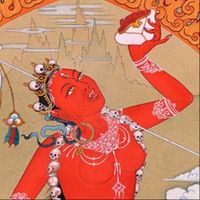
Easy. “Wrathful Yidam”
-
93
This one has a delicious Crowley-paradox baked in. Ra-Hoor-Khuit is anti-“Buddhist religion” in Liber AL rhetoric, but not anti-Buddhist technique or realization. Crowley attacks Buddhism as an old-aeon creed, while still using Buddhist method, vocabulary, and attainment-models as some of his best technical comparators. Wrapping a description of Ra-Hoor-Khuit with an analysis of how Buddhism overlaps with Thelema may help. Any failure to that end is entirely mine and not a reflection of Thelema or Uncle Al.
Ra-Hoor-Khuit is the active, outward, conquering form of Horus in the New Aeon. Crowley treats him not merely as an Egyptian god-name, but as a magical formula: the visible, operative result of the union of Nuit and Hadit.
In Magick in Theory and Practice, Crowley gives the cleanest metaphysical definition: Nuit is infinite space, Hadit is the infinitely small omnipresent point, and the conjunction of these infinities is called Ra-Hoor-Khuit, “a unity which includes and heads all things.” In plain language: Ra-Hoor-Khuit is the universe becoming active as Will — the infinite field and the point of experience suddenly expressed as force, direction, and event. [1]
Crowley also identifies him as part of the double god Heru-Ra-Ha. In Book of Thoth, he says Heru-Ra-Ha has two forms: Ra-Hoor-Khuit, the extroverted or active form, and Hoor-pa-kraat, the passive or introverted form. The same passage says he is solar in character, coming forth in golden light. [2]
So, simplified: Hoor-pa-kraat is the silent seed; Ra-Hoor-Khuit is that seed bursting forth as action.
Crowley says almost exactly that in the New Comment to Liber AL: Hoor-pa-kraat is the “Babe in the Egg of Blue,” the unmanifest Higher Self or Holy Guardian Angel; when he appears, he takes the active twin-form of Ra-Hoor-Khuit. Crowley’s phrase is that the “Concealed Child becomes the Conquering Child,” and he equates this with the hidden Silent Self springing forth as the Word of one’s True Will. [3]
That gives us the psychological definition: Ra-Hoor-Khuit is the awakened Will, no longer latent, silent, or gestating. He is the “child” because he belongs to the new Aeon; he is “crowned and conquering” because this Will does not ask permission from old moralities, old gods, or old formulas.
Crowley’s aeonic definition is just as important. In his early commentary material, he says the Isis period was pastoral and natural, the Osiris period was characterized by sorrow, death, and sacrifice, and the Horus period brings the “young child” who rises strong and conquering with his twin Harpocrates. He explicitly places Buddha and Christ in the Osirian period, not the Horus period. [4]
So Ra-Hoor-Khuit is Crowley’s name for the ruling god-form of the post-Osirian Aeon: no longer salvation by suffering, but realization by force, fire, joy, ordeal, and Will.
Crowley’s qabalistic gloss adds another layer. In the Old/New Comment to Liber AL III:1, he says Abrahadabra is the reward/formula of Ra-Hoor-Khuit; he connects the god with the Great Work, the balancing of 5 and 6, the Rose and Cross. He glosses Ra as solar, Hoor as warrior/Mars, and Khu as the magical ego of a star, with the inserted i/yod transmuting the name into godhead. [5]
That is very Crowley: half Egyptian, half qabalistic engine-room.
In Liber V vel Reguli, he compresses Ra-Hoor-Khuit into the formula ShT: Shin as fire, Teth as force, conjoined to express Ra-Hoor-Khuit. He then links this formula with the Aeon, magic, the Sun, the Lion, the Serpent, courage, and sexual love. [6]
So practically, Ra-Hoor-Khuit is not merely “war” in the crude military sense; he is force-fire applied through the magical formula of the Aeon.
And yes, the war imagery is real. Liber AL III has Ra-Hoor-Khuit speak as a god of war and vengeance, and Crowley’s New Comment interprets this not only literally but mystically: the “god of War and Vengeance” is one who causes people to do their Wills by “Going as Gods do,” instead of checking the course of Nature. [6]
That is the key softener: Crowley’s “war” is often cosmological and initiatory before it is political. It is the violence of manifestation itself, the strike of Will through inertia. Not exactly cozy. Very much not chamomile tea.
Thus, Ra-Hoor-Khuit is Crowley’s active Horus: the solar-martial, crowned-and-conquering Child of the Aeon, born from the union of Nuit and Hadit, representing the awakened True Will as force, fire, joy, ordeals, and victorious magical action.
Some have wondered if Ra-Hoor-Khuit overlaps with Buddhism. Directly, as a named Buddhist figure? No. Crowley does not identify Ra-Hoor-Khuit with Buddha, a Bodhisattva, a Dharmapāla, Heruka, Mahākāla, or any Buddhist deity in the sources I've read. In fact, Liber AL III explicitly includes “the Buddhist” among the old religious forms attacked by the Hawk-headed Lord, and Crowley’s New Comment says roughly that the same criticisms he makes of religion in India apply to Buddhism as practiced. [7]
Functionally and technically, yes, there are overlaps — mostly at the levels of meditation, ego-destruction, wrathful enlightened energy, and the transition from silence to action.
First, Crowley deeply respected Buddhist method. In Book 4, he says Buddha is the only great religious founder who explains his system thoroughly and is “not dogmatic,” and he calls the Buddhist system the best document for studying mystical attainment. He then reduces prayer and meditation to the same essential act: restraining the mind to a single act, state, or thought. [8]
That matters because Ra-Hoor-Khuit’s twin, Hoor-pa-kraat, is the silent interior form; the RHK formula only becomes meaningful after the silent center has been found.
Second, Crowley explicitly treats Buddha’s conquest of Mara as a model of magical vow and concentration. In Book 4, he describes Buddha under the Bo-tree taking the oath not to rise until attainment, even when Mara and the temptresses appear; then Crowley says Buddha attacked the ego first. [9]
That has a real structural overlap with Ra-Hoor-Khuit: both are “conquering” images, but the real enemy is not merely external. It is inertia, ego, fear, false selfhood, and the old spell of “Because.”
Third, Crowley connects his own Egyptian-Thelemic cosmology to Samadhi. In Eight Lectures on Yoga, he says Nuit as Space and Hadit as point-of-view unite and produce Heru-Ra-Ha, combining Ra-Hoor-Khuit and Hoor-pa-kraat, and then says this system corresponds closely to a great state of mind reflecting the experience of Samadhi. [10]
That is probably the strongest Crowley-internal bridge to Buddhist and yogic traditions: Ra-Hoor-Khuit is not a Buddhist deity, but the Heru-Ra-Ha formula maps onto states of consciousness that Crowley discusses in the same technical neighborhood as Samadhi.
Fourth, there is an overlap with the Bodhisattva / compassionate activity problem, though Crowley handles it in his own acid-soaked way. In his commentary on The Voice of the Silence, Crowley says the Master of the Temple has learned that “Everything is sorrow” and that there is no separate existence; therefore his task is not complete while any fragment of consciousness remains unemancipated from illusion. That is very close to a Mahayana-style logic of non-separate liberation. But Crowley immediately strips it of sentimentalism. For him, the Master acts not because he is “nice,” but because it is his nature/function to do so. [11]
That is a very Ra-Hoor-Khuit spin on compassion: not pity, but necessity under Will.
Fifth, there is a partial analogy to wrathful Buddhist forms, especially in Tibetan/Vajrayana material — but this is my comparison, not Crowley’s explicit identification. Sacred-texts material on Tibetan Buddhism describes wrathful deities as changed aspects of peaceful deities, and other sacred-texts material describes fierce meditational deity imagery with weapons, blood, skulls, and demon-conquest. [12]
That resembles Ra-Hoor-Khuit only in function: terrible form as awakened energy, not evil. But Crowley himself does not say “Ra-Hoor-Khuit is a Buddhist wrathful deity,” so I would treat this as a comparative resonance, not a doctrinal equation.
The biggest difference is Nibbana/Nirvana versus Thelemic manifestation. Crowley’s Science and Buddhism treats Buddhist Nibbana/Nirvana as a serious technical problem of cessation, not as a disguised heaven. [13]
But in Magick Without Tears, he says Thelemites cannot practically accept a plan that treats perfection as mere absence or cessation; Thelemic Nothing wants to enjoy itself by realizing all possibilities in manifestation. [14]
This is the philosophical fork in the road.
Buddhist attainment, as Crowley understood it, moves strongly toward cessation, ego-extinction, non-attachment, and release from illusion. Ra-Hoor-Khuit accepts the “Nothing” behind things, but insists that Nothing express itself as force, joy, creation, ordeal, love, and Will.
That is why Ra-Hoor-Khuit can sound anti-Buddhist while still using Buddhist machinery. He is not the Buddha; he is more like Crowley’s answer to what comes after the Buddha’s silence: the awakened point rises from the egg and acts.
Crowley’s Ra-Hoor-Khuit only makes sense when paired with Hoor-pa-kraat, the silent form. Crowley says the dual character of the god is vital: the Sign of the Enterer must be followed by the Sign of Silence. [15]
That is almost a ritual theorem: every projection of force must be rooted in silence; every magical strike must return to stillness.
That is where the Buddhist correlation is strongest. Crowley admired Buddhist discipline because it knows how to still the mind, attack ego, and reach the threshold where reason fails. But Ra-Hoor-Khuit is what happens when Crowley refuses to stop at stillness. He wants the silence to become a Word, a child, a sword, a solar act.
Ra-Hoor-Khuit is the active face of awakened consciousness in Thelema: the silent Self of Hoor-pa-kraat released into manifestation as solar-martial Will. He overlaps with Buddhist traditions not as a named deity, but as a technical cousin to Buddhist conquest of ego, meditative attainment, and wrathful enlightened activity. The difference is that Buddhism, especially as Crowley frames it, tends toward cessation or release, while Ra-Hoor-Khuit is the ecstatic eruption of Nothing into all possible acts.
93 93/93
Hello! It looks like you're interested in this conversation, but you don't have an account yet.
Getting fed up of having to scroll through the same posts each visit? When you register for an account, you'll always come back to exactly where you were before, and choose to be notified of new replies (either via email, or push notification). You'll also be able to save bookmarks and upvote posts to show your appreciation to other community members.
With your input, this post could be even better 💗
Register Login